
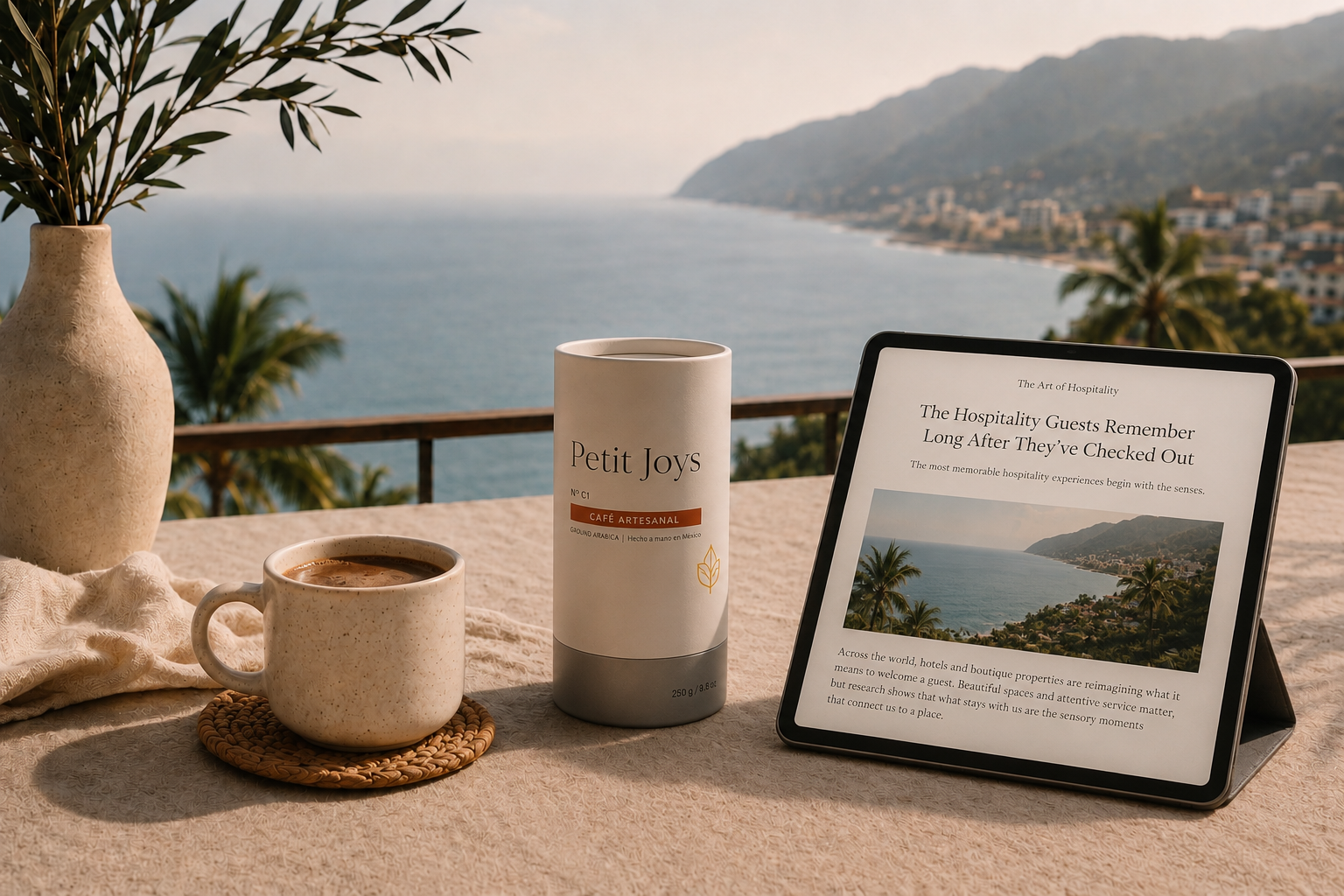
What Guests Remember Long After They’ve Checked Out!
The most memorable hospitality experiences begin with the senses.
Hospitality has never been more thoughtful. Across the world, hotels, boutique properties, vacation rentals, and luxury residences are reimagining what it means to welcome a guest. Beautiful architecture, exceptional service, and carefully designed spaces remain essential, yet a growing body of hospitality research suggests that the experiences guests remember most often have very little to do with marble lobbies, designer furnishings, or elaborate welcome baskets.
While reviewing hospitality publications, guest experience studies, and hundreds of traveler reviews, one pattern emerged with remarkable consistency. Guests rarely described the most expensive amenities. Instead, they remembered the cup of locally roasted coffee waiting for them on their first morning, the fragrant herbal tea that helped them unwind after a long flight, the handwritten note that made them feel genuinely welcomed, or the small jar of local honey that somehow found its way home in a suitcase.
Hospitality professionals have begun recognizing something that feels both simple and profound: the experiences guests remember most are often the ones that create an emotional connection — ones that introduce visitors to the destination, encourage moments of rest after travel, or become part of a quiet daily ritual that continues long after the journey has ended. At Petit Joys, this observation resonated deeply with us. We have never believed hospitality is measured by the number of amenities a guest receives. We believe it is measured by the memories those amenities create.

The details guests carry home are rarely the grandest ones.
The senses are where memories begin
Neuroscientists have long understood something the hospitality industry is only beginning to embrace. Among all of our senses, smell has one of the closest relationships with memory because scents are processed by parts of the brain responsible for emotion and recollection. A familiar aroma can instantly transport us to another place, often years after the experience itself — the smell of coffee drifting through an open balcony overlooking the Pacific, fresh herbs steeping into an evening tea, warm cacao shared during a quiet sunrise, lavender settling into the room before sleep.
Yet memorable hospitality rarely relies on a single sense. The experiences that remain with us engage several at once. We taste the destination through its food, recognize it through its aromas, feel it through comforting textures, and quietly build rituals around those moments until they become part of the story we tell about our travels. That realization has shaped the way we think about hospitality at Petit Joys — rather than designing products, we strive to create experiences that guests can taste, smell, feel, and remember.

Scent, taste, and texture work together to anchor a memory in place.
A taste of place
Food has always been one of the most authentic ways people experience a destination. In recent years, culinary tourism has become one of the fastest-growing segments of travel because visitors increasingly want more than beautiful scenery — they want to understand a place through its traditions, ingredients, and local culture. A cup of coffee roasted in Puerto Vallarta tells a different story than an imported blend. Artisan honey reflects local flowers and seasons. Traditional jams, regional salsas, ceremonial cacao, and handcrafted teas become introductions to Mexico itself.
This philosophy inspired our Taste of Mexico collection. Rather than assembling products that could be found anywhere in the world, we collaborated with artisans whose work reflects the richness of Mexican traditions. Every ingredient, every aroma, and every story invites guests to experience Puerto Vallarta not simply as visitors, but through the flavors and craftsmanship that define the region.

The Taste of Mexico collection — artisan honey, jam, and salsa macha sourced from local producers in Puerto Vallarta.
The gift of recovery
Travel has always been associated with excitement, but it also places genuine demands on the body. Long flights, changing time zones, destination weddings, conferences, and busy itineraries often mean guests arrive carrying more fatigue than they realize. It is one reason many hospitality professionals are beginning to rethink the traditional welcome basket — the focus has shifted from novelty toward wellbeing. A calming herbal tea, a spoonful of local honey, or a lavender pillow mist may appear simple, yet together they communicate something far more meaningful: We're glad you're here, and we'd like you to feel at home.
That idea became the inspiration behind our Sweet Dreams collection. Pairing artisan honey, our calming herbal tea, and a lavender pillow mist developed with our aromatherapist, the collection was designed as a gentle evening ritual that helps guests slow down, sleep well, and wake ready to experience everything the destination has to offer.
Sometimes the greatest luxury isn't extravagance. It's feeling restored.

The Sweet Dreams collection — artisan honey, calming herbal tea, and lavender pillow mist for a restorative evening ritual.
Why rituals matter
Anthropologists have long observed that rituals exist in every culture because they transform ordinary moments into meaningful ones. Hospitality has always relied on them, even if we rarely describe them that way — morning coffee on the terrace, tea before bed, watching the sunset from the same chair each evening, preparing a warm cup of cacao before beginning the day. These small habits quietly become the moments guests remember long after much of the itinerary has faded.
Our Mushroom Cacao was designed with this philosophy in mind. Blending ceremonial cacao with functional mushrooms traditionally appreciated for supporting focus and mental clarity, it offers a gentle morning ritual for guests who prefer a slower beginning to the day. Our Mayan Cacao tells a different story — inspired by ancient Mesoamerican traditions, it celebrates one of Mexico's oldest ceremonial beverages, prepared long before cacao became associated with desserts. We wanted to honor that heritage while inviting guests to create a meaningful ritual of their own.
Hospitality is rarely remembered because of a single object. It is remembered because of the moments those objects create.

Mushroom Cacao and Mayan Cacao — two morning rituals rooted in Mexican tradition and mindful intention.
The Lasting Stay
Perhaps the most surprising observation from our research had nothing to do with arrival. Hotels devote enormous attention to the guest's first impression — the room, the breakfast, the concierge recommendations — and every detail is thoughtfully curated until checkout. Then, quite suddenly, hospitality ends. Memory doesn't. It continues quietly, sometimes for years.
At Petit Joys, we've come to think of this final chapter as The Lasting Stay — the moment guests return home and, weeks later, brew the coffee they discovered in Puerto Vallarta, prepare the herbal tea they enjoyed before bed, or reach for the body butter that reminds them of afternoons beneath the Mexican sun. A familiar fragrance fills the room, and without warning they find themselves back on a balcony overlooking Banderas Bay. Many of our hospitality collections were intentionally designed with this in mind: some create memorable moments during a stay, others quietly continue the experience long after the suitcase has been unpacked.
Great hospitality shouldn't end at checkout. The most memorable places find a way to accompany guests home.

The Lasting Stay — when a familiar scent or flavor brings a guest back to the place they fell in love with.
Beyond amenities
At Petit Joys, we often say that gifts should fill hearts, not just space. We believe the same is true of hospitality. The places we remember most are rarely defined by their longest list of amenities — they are remembered because they helped us feel connected: to a destination, to local traditions, to thoughtful craftsmanship, and to the people who welcomed us there.
Perhaps that is what hospitality has always been about. Not impressing guests. Helping them feel something worth remembering. Because sometimes the most meaningful part of a stay doesn't happen during the visit at all.
Sometimes… it begins only after we've gone home.



Leave a comment
This site is protected by hCaptcha and the hCaptcha Privacy Policy and Terms of Service apply.